Political language provides a useful setting for studying how communication changes over time and how those changes relate to broader social and cultural trends. In this project, we analyzed transcripts from U.S. presidential debates between 1976 and 2024 to investigate differences in language across candidates, political parties, and election years.
The analysis began with word-volume and threat-language measurements. We separated transcripts by speaker and tracked the frequency of words associated with topics such as taxation, security, weapons, war, international relations, and economic concerns. This provided a first look at how the subjects emphasized during presidential debates shifted across different election cycles.
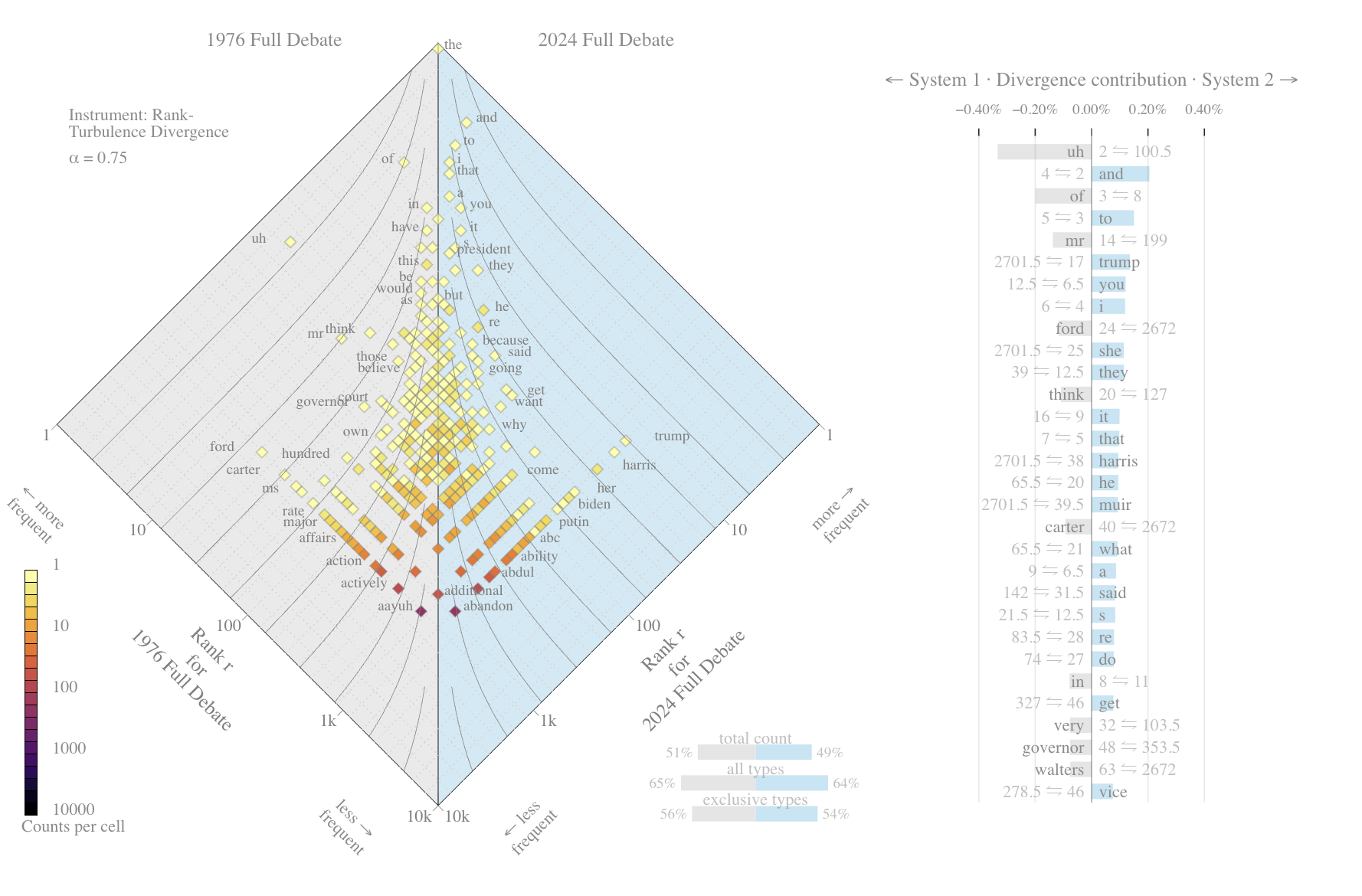
To compare language more systematically, we applied allotaxonometry, a method for comparing large frequency distributions using rank-turbulence divergence. By constructing allotaxographs from debate transcripts, we were able to identify which words contributed most strongly to differences between candidates, parties, and time periods. These comparisons revealed changes in both major policy topics and subtler linguistic features such as pronoun and function-word usage.
I also applied ousiometric analysis to quantify the semantic character of each candidate’s language. Using danger, aggression, power, goodness, and structure metrics, debate transcripts were mapped into a low-dimensional semantic space and tracked across election years. This provided a quantitative way to compare rhetorical characteristics that are difficult to capture through word frequency alone.
One of the more interesting results was how similar candidates from opposing political parties appeared under these measures. Democratic and Republican candidates frequently occupied similar regions of semantic space within the same election year, while changes across time were often larger than differences between parties. The debate format itself may therefore impose a relatively consistent linguistic environment across candidates.
The analysis also found that presidential debates generally occupied a region characterized by comparatively safe, moderately powerful language. Although individual years showed deviations, the overall semantic structure remained relatively stable across several decades.
The Electometer combined natural language processing, statistical analysis, and complex-systems methods to investigate political communication at multiple scales. Rather than relying on individual phrases or subjective impressions of political rhetoric, the project used several complementary quantitative approaches to examine how patterns of language emerge and evolve over time.