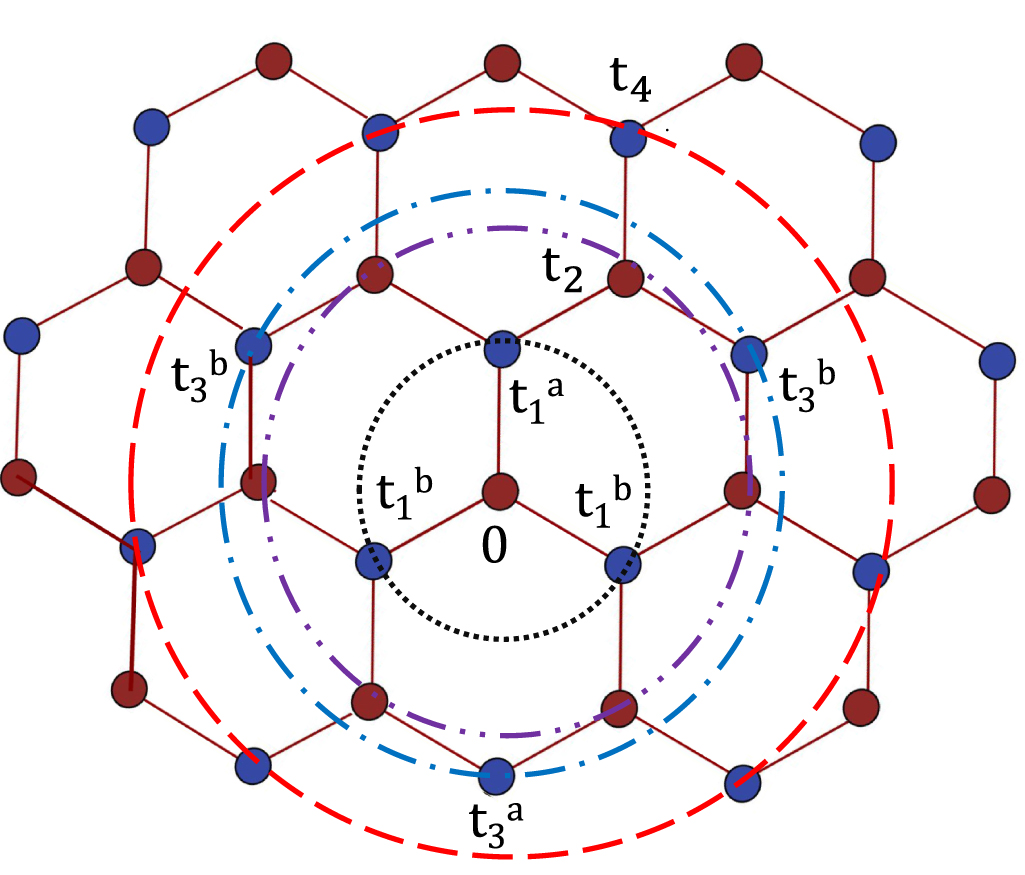
Semi-Dirac systems host quasiparticles with linear dispersion in one momentum direction and quadratic dispersion in the other. This anisotropic structure produces an unusual density of states and can significantly affect how localized electronic states interact with the surrounding material.
In this project, I applied the Anderson impurity model to study the formation of localized magnetic moments in semi-Dirac systems. The model describes an impurity state coupled to conduction electrons, with the competition between hybridization and electron-electron interactions determining whether the impurity becomes magnetic.
I developed numerical methods to calculate the impurity self-energy and spectral function across a range of model parameters. I then used self-consistent calculations and parameter sweeps to identify the boundary between magnetic and non-magnetic impurity states.
The analysis focused on how anisotropic dispersion, impurity energy, hybridization strength, Coulomb interaction strength, quasiparticle velocity, and effective mass influence moment formation. I also compared conventional type-I semi-Dirac systems with topologically nontrivial type-II models, which have different dispersions and densities of states.
This work connected theoretical condensed-matter physics with scientific programming and numerical analysis, providing insight into impurity behavior in anisotropic and low-dimensional materials.