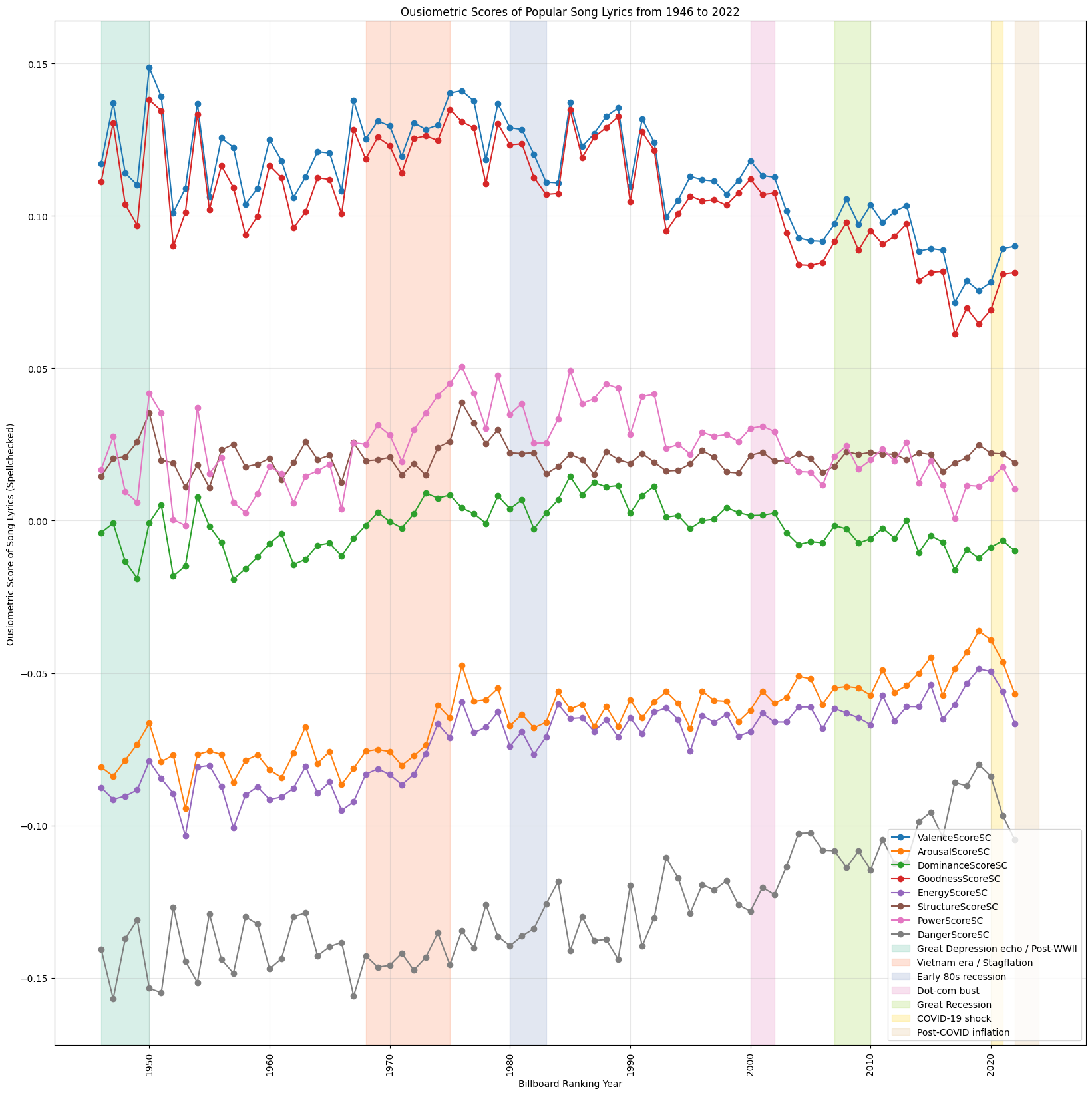
Popular music is often described as reflecting the broader cultural and economic environment in which it is produced. In this project, we investigated the idea of “recession pop” by asking whether the emotional content of popular music changes systematically with economic conditions.
We analyzed lyrics from 6,032 Billboard Hot 100 songs spanning 1946 to 2022 and compared their emotional characteristics with U.S. macroeconomic indicators including unemployment, inflation, GDP growth, interest rates, and debt-to-GDP ratio.
Rather than relying on a single measure of sentiment, we analyzed lyrics using four complementary approaches. Hedonometer scores measured overall happiness, ousiometric analysis captured semantic dimensions such as valence, power, danger, energy, and structure, VADER provided rule-based sentiment scores, and a DistilRoBERTa emotion classifier estimated the prevalence of emotions including anger, fear, joy, sadness, disgust, and surprise.
The resulting time series showed a pronounced long-term shift in popular lyrics. Across multiple independent sentiment methods, lyrics became less positive and increasingly negative or emotionally intense over the second half of the twentieth century and into the twenty-first. Hedonometer scores, for example, declined from their highest value in 1950 to their lowest in 2019.
To determine whether these changes could be explained by economic conditions, I combined the lyrical measurements with macroeconomic data from the Federal Reserve Economic Data database. Because many economic and cultural variables exhibit long-term trends, we tested for stationarity and used first differences before calculating correlations. Benjamini-Hochberg false-discovery-rate correction was then applied to account for the large number of statistical comparisons.
Although several individual relationships initially appeared statistically significant, none remained significant after multiple-testing correction. This suggested that annual changes in economic conditions were not strongly associated with changes in lyrical emotion, despite the clear long-term emotional shift in popular music.
We also developed a walk-forward forecasting pipeline to test whether macroeconomic variables could predict future lyrical emotion. Ridge regression, ElasticNet, Random Forest, and XGBoost models were compared using historical backtesting, lagged economic variables, rolling averages, and autoregressive features. Random Forest produced the lowest prediction error, but the models generally struggled to reproduce year-to-year variation, reinforcing the conclusion that macroeconomic indicators provide relatively little predictive signal for lyrical sentiment at an annual scale.
Overall, the project combined natural language processing, time-series analysis, statistical hypothesis testing, and machine learning to examine a popular cultural hypothesis using several decades of music and economic data. The results suggest that the idea of “recession pop” may be more complicated than a direct response to economic downturns, while revealing a much stronger long-term change in the emotional character of popular music.