Online creative communities constantly invent new vocabulary to describe tropes, themes, and styles of writing. On Archive of Our Own (AO3), much of this vocabulary lives in freeform tags, which users create and apply themselves. Most new tags stay small and local, but some spread well beyond the community where they began and become common terms across the site. This makes AO3 a natural setting for studying how ideas move through a network of interconnected communities.
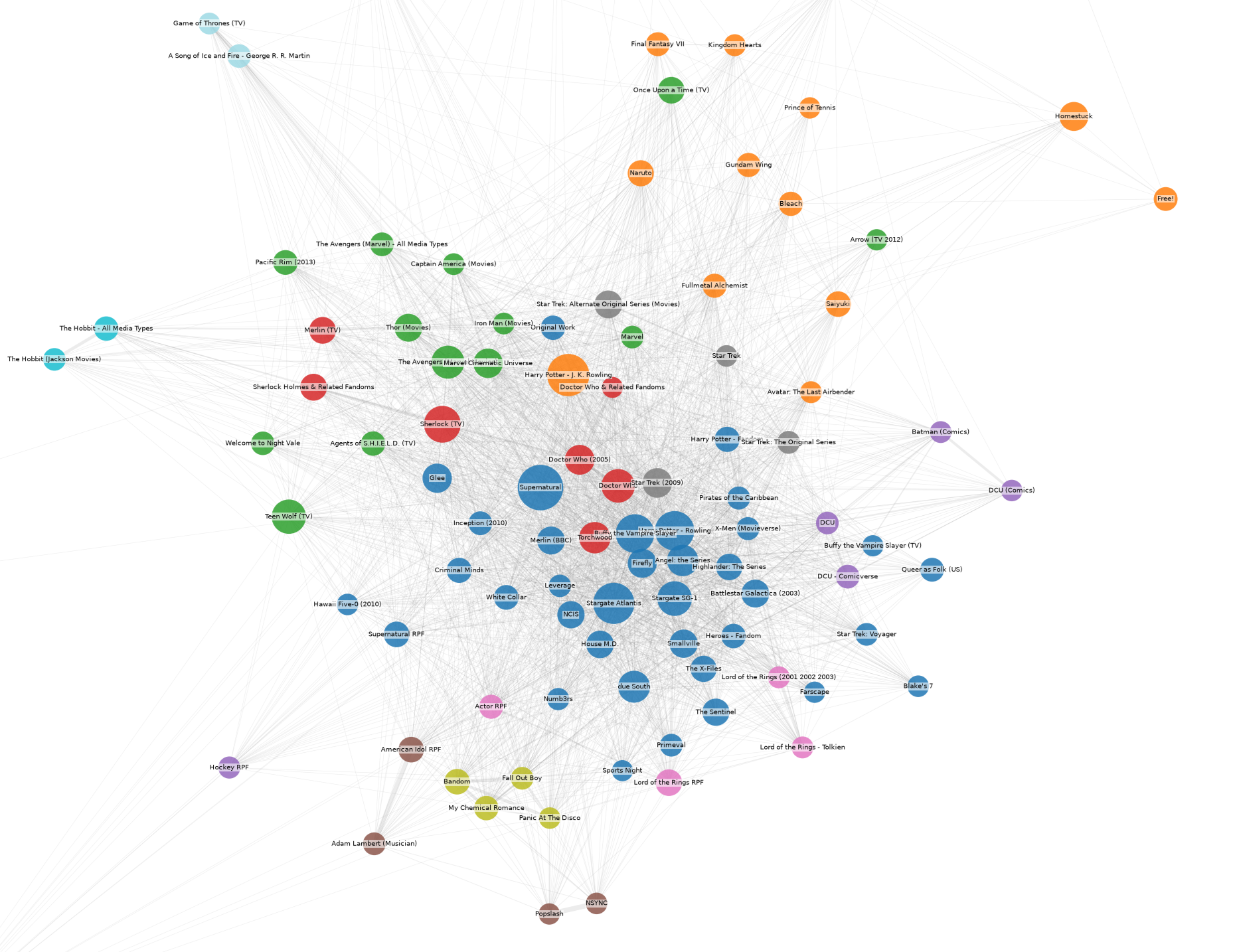
To represent the structure tags spread through, I constructed an inter-fandom network from AO3 work metadata. Each node is a fandom, and two fandoms are linked through crossover works tagged with both and through authors who have written in both. Because large fandoms share authors with nearly everything simply because of their size, I normalized each link by the geometric mean of the two fandoms’ author counts. This highlights pairs of fandoms that overlap more than their sizes alone would predict.
I laid out the network with the Fruchterman–Reingold force-directed algorithm, which treats nodes as repelling particles and weighted links as springs pulling connected fandoms together. The resulting layout places strongly connected fandoms near one another, so distance in the layout serves as a measure of how closely two communities are linked. I also identified communities by modularity maximization, which groups fandoms that are more densely connected to each other than expected by chance. Without any information about genre or media type, the method recovered recognizable clusters, including anime and manga, Marvel films, BBC television, Star Trek, music-based fandoms, and older science fiction and television.
Using this network, I identified emerging tags by their first appearance and low initial usage, then tracked their adoption across fandoms over time. A tag was considered to have reached a fandom once works in that fandom began using it. Beyond this first appearance, I measured each tag’s density in a fandom as the fraction of new works using it, along with the rate at which that density increased. This distinguished fandoms where a tag appeared only a handful of times from those where it genuinely caught on.
New tags took hold significantly faster in fandoms closely connected to their origin, with tag density growing more slowly in more distantly linked communities. Spread frequently followed inter-fandom connections, moving along existing links between communities rather than appearing independently in unrelated parts of the network. Reader response also mattered: the average kudos received by works using a new tag correlated with the likelihood that the tag would spread, suggesting that tags attached to well-received writing were more likely to be picked up by other communities.
Overall, the project combined network construction, force-directed visualization, community detection, and time-series analysis of tag usage to study how new vocabulary emerges and diffuses through online creative communities. By treating tags as measurable traces of cultural spread, it showed how both network structure and reader response shape which ideas travel beyond their origin.
Note: The network and analysis presented here are based on a partial segment of the Archive of Our Own dataset, selected for practical and methodological reasons. Patterns in the full archive may differ.