The Van der Pol oscillator is a nonlinear dynamical system originally developed to describe oscillations in vacuum-tube circuits. Its combination of nonlinear damping and self-sustained oscillation makes it a useful model for studying limit cycles, relaxation oscillations, and time-scale separation in physical and engineering systems. In this project, I studied how the oscillator’s behavior changes across different values of the nonlinearity parameter .
For small values of , the nonlinear damping is weak and the system behaves approximately like a simple harmonic oscillator. I used perturbation theory to construct an approximate solution by expanding the motion in powers of , then compared this analytical approximation with numerical solutions of the Van der Pol equation. For , the numerical and zeroth-order solutions agreed closely, while increasing produced progressively larger deviations as nonlinear effects became more important. I also used phase-plane analysis to examine the oscillator’s stable limit cycle. At small , the trajectory is nearly circular, reflecting approximately harmonic motion. As the nonlinear damping becomes stronger, the limit cycle deforms and develops increasingly distinct regions of slow and rapid motion. The nonlinear damping adds energy when the oscillation amplitude is small and removes energy at larger amplitudes, producing a stable self-sustained oscillation.
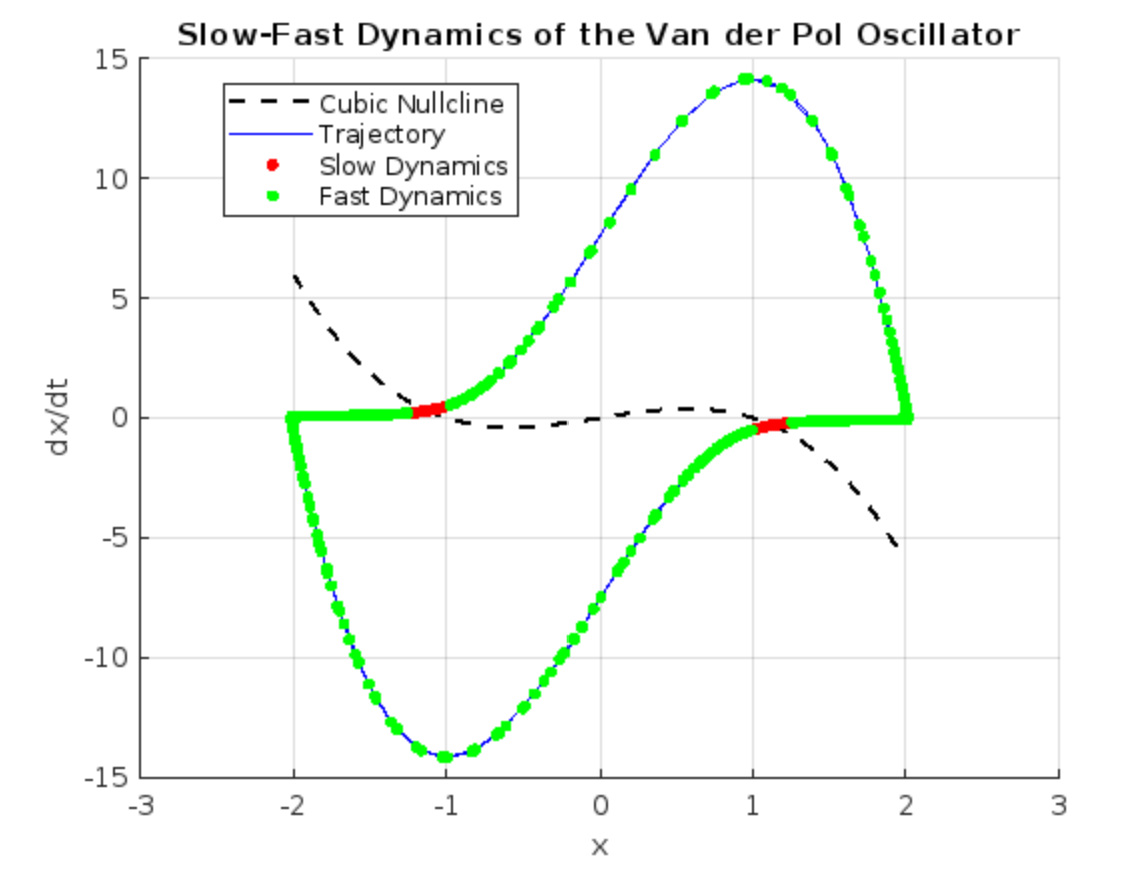
In the large- regime, the system develops relaxation oscillations with a clear separation between slow and fast dynamics. The trajectory spends most of its time evolving slowly along portions of a cubic nullcline before rapidly transitioning between branches. I numerically simulated this behavior and visualized the corresponding slow and fast portions of the phase-space trajectory.
Using the slow-fast structure, I also examined an analytical approximation for the period of the limit cycle. Because the rapid transitions contribute relatively little to the total period, the dominant contribution comes from the slow portions of the trajectory, leading to a large- approximation of
The numerical work was implemented in MATLAB using differential-equation solvers to generate phase portraits, compare analytical and numerical solutions, and identify slow and fast regions of the trajectory. The visualization used for this project shows the simulated limit cycle together with the cubic nullcline and classifications of the slow and fast dynamics.
Finally, I considered the physical relevance of these dynamics in nonlinear electronic systems. Stable limit cycles and relaxation oscillations provide useful models for signal-generating circuits, waveform generators, multivibrators, and other systems in which nonlinear feedback regulates sustained oscillations. This project connected analytical methods for differential equations with numerical simulation and practical examples from physics and electrical engineering.